Male-Male Intimacy in Early America by William E Benemann
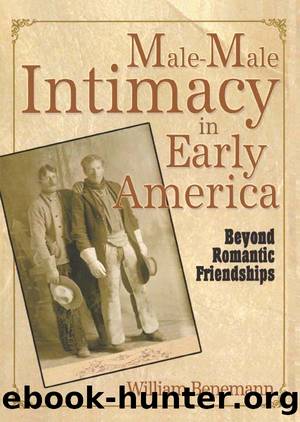
Author:William E Benemann [Benemann, William E]
Language: eng
Format: epub
ISBN: 9781317953449
Publisher: Taylor and Francis
Published: 2014-06-03T04:00:00+00:00
Chapter 7
The Nationâs Capital Under Jefferson: Four Case Studies
Mr. Jefferson ⦠was playing a game for retaining the highest offices in the state where manners are not a prevailing feature in the great mass of the Society being, except in the large towns, rather despised as a mark of effeminacy by the majority who seem to glory in being only thought men of bold strong minds and good sound judgement.
Augustus John Foster
Washington City during the presidency of Thomas Jefferson provided an unusual opportunity for the country to sort out its shifting attitudes about gender roles, in particular American expectations about masculinity. Washington was an artificial instant city, a tabula rasa without the encumbering social legacies of New York, Boston, or Philadelphia. Although it was a Southern city, it was filled with representatives from all parts of the new country as well as the diplomatic corps from abroad, diluting any strong regional prejudices. It was also a strange hybrid: a population center with fervent cosmopolitan aspirations but with a decidedly skewed gender ratio. Like a small camp on the roughest edge of the frontier, Washington had a population that was transient and predominately male. Three politicians came to Jeffersonâs capital handicapped by somewhat ambiguous gender presentations, and their stories reveal much about the options available to men who were ill equipped to follow the standard heterosexual path. A fourth man used accusations of sexual irregularity as a weapon against men of influence, but ended by having the weapon turned on himself.
History has not been kind to Anthony Merry, the British minister to America during part of Jeffersonâs tenure as president. He has been judged to be âthe least well bred and among the stupidestâ of the many envoys from the Court of St. James, a âthin-skinned, almost stupid man,â âself-important,â and a âvain, irascible, weak man, as poor a diplomat and ambassador as Great Britain had ever sent from her shores.â1 He might more charitably be viewed as a man whose diligence and fastidious loyalty to the crown raised him to a position beyond his natural talents. He certainly served the king to the best of his ability, even though he lacked the self-confidence needed to cope with the communications difficulties inherent in a posting so far away from London, and he was ill equipped to flourish in the messy democratic leveling that Jefferson brought to the social functions of the nationâs capital.
Merry was born in London in 1756, the son of a merchant in the Spanish wine trade who was declared bankrupt when Anthony was eighteen. Because of the nature of his fatherâs business Merry was fluent in Spanish, and he began his own career as a business associate of the British consul at Málaga. In 1783 he entered the diplomatic service, using his slim life savings to obtain the post of British consul at Majorca. The Majorca posting led to a more prestigious appointment as British consul general at Madrid, and after two years he was named chargé dâaffaires in the absence of the British ambassador.
Download
This site does not store any files on its server. We only index and link to content provided by other sites. Please contact the content providers to delete copyright contents if any and email us, we'll remove relevant links or contents immediately.
| Anthropology | Archaeology |
| Philosophy | Politics & Government |
| Social Sciences | Sociology |
| Women's Studies |
Cecilia; Or, Memoirs of an Heiress — Volume 1 by Fanny Burney(32558)
The Great Music City by Andrea Baker(32019)
Cecilia; Or, Memoirs of an Heiress — Volume 2 by Fanny Burney(31956)
Cecilia; Or, Memoirs of an Heiress — Volume 3 by Fanny Burney(31942)
We're Going to Need More Wine by Gabrielle Union(19046)
All the Missing Girls by Megan Miranda(16027)
Pimp by Iceberg Slim(14507)
For the Love of Europe by Rick Steves(14121)
Bombshells: Glamour Girls of a Lifetime by Sullivan Steve(14075)
Talking to Strangers by Malcolm Gladwell(13370)
Norse Mythology by Gaiman Neil(13365)
Fifty Shades Freed by E L James(13241)
Mindhunter: Inside the FBI's Elite Serial Crime Unit by John E. Douglas & Mark Olshaker(9343)
Crazy Rich Asians by Kevin Kwan(9292)
The Lost Art of Listening by Michael P. Nichols(7506)
Enlightenment Now: The Case for Reason, Science, Humanism, and Progress by Steven Pinker(7313)
The Four Agreements by Don Miguel Ruiz(6765)
Bad Blood by John Carreyrou(6621)
Weapons of Math Destruction by Cathy O'Neil(6280)
